




EFCC Appeals Court Ruling Rejecting Forfeiture of $912,550 Linked to Ex-Warri Refinery MD

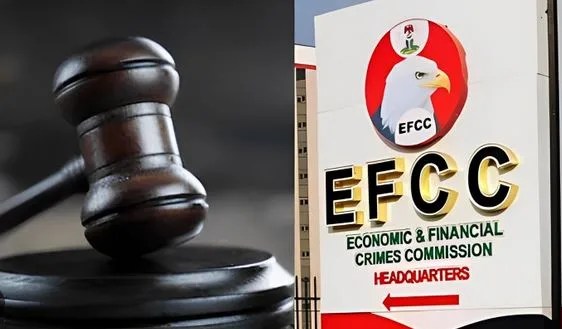

The Economic and Financial Crimes Commission (EFCC) has approached the Court of Appeal in Abuja to challenge a Federal High Court judgment dismissing its application for the permanent forfeiture of $912,550 and two properties linked to Jimoh Olasunkanmi Yisawu, a former Managing Director of the Warri Refining and Petrochemical Company.
The appeal comes after Justice James Omotosho of the Federal High Court, Abuja, on Monday, November 9, 2026, ruled that the anti-graft agency failed to establish sufficient grounds to prove that the disputed funds and properties were proceeds of unlawful activities.
Following the ruling, the judge discharged the interim forfeiture order previously placed on the assets and rejected the EFCC’s request to permanently transfer them to the Federal Government.
Unwilling to accept the decision, the commission filed a notice of appeal before the Court of Appeal on Tuesday, November 10, through its lead counsel, Ekele Iheanacho, SAN.
The EFCC announced the development in a statement released on Wednesday by its spokesperson, Dele Oyewale, insisting that the trial judge failed to properly evaluate crucial financial records and evidence relating to Yisawu’s declared income, financial transactions and property acquisitions.
In its appeal, the commission argued that the judge committed an error of law by failing to give adequate consideration to the financial evidence presented during the forfeiture proceedings.
According to the EFCC, the transactions allegedly linked to the former refinery chief were inconsistent with his documented earnings as a public officer.
Questioning the source of the funds, Iheanacho said the central issue was how a public officer with a documented income could allegedly give out more than $900,000 in cash.
“The case rests on a simple question: how does a public officer whose lawful income is documented give out over $900,000 in cash?” he queried.
The commission alleged that its investigations uncovered cash transactions amounting to $912,550 involving Yisawu and two bureau de change operators, Samaila Bala and Rasheed Yusuf, between 2021 and 2025.
According to the EFCC, the foreign currency was allegedly handed over to the operators for conversion into naira, with the total naira equivalent exceeding ₦1.5 billion.
The agency maintained that although Yisawu claimed the money came from legitimate earnings and loans, he failed to explain how he converted his lawful income into the substantial amount of foreign currency allegedly paid to the dealers.
“The respondent did not show how he converted his legitimate earnings into foreign currency which he paid to Samaila Bala and Rasheed Yusuf,” the commission stated.
The EFCC also questioned the trial court’s assessment of Yisawu’s financial capacity, arguing that his declared assets and documented earnings did not sufficiently support the volume of transactions under investigation.
The commission disclosed that Yisawu declared cash holdings and bank balances of ₦647,205.36 and $12,779.26 as of September 17, 2020.
It further stated that his salaries and allowances between October 2020 and September 2023 amounted to ₦114,548,024.48.
According to the anti-graft agency, these declared earnings were significantly lower than the value of the foreign currency transactions allegedly carried out through the bureau de change operators.
The commission argued that the trial judge failed to properly examine the relationship between Yisawu’s documented income, his financial outflows and the money allegedly used to develop the two disputed properties.
It particularly faulted the judgment for failing to analyse the financial movements from the respondent’s bank accounts before concluding that the funds used for the property developments came from legitimate earnings.
Beyond the alleged foreign currency transactions, the EFCC claimed that the two bureau de change operators indirectly contributed ₦282,542,000 towards the development of the properties.
The commission also alleged that one of the operators, Bala, made payments totalling ₦65,860,000 to Cordros Securities Limited in three instalments on February 21, 2024, for the purchase of treasury bills.
It insisted that these transactions were not adequately linked to Yisawu’s legitimate income and should have received greater consideration during the forfeiture proceedings.
Consequently, the EFCC is asking the Court of Appeal to overturn Justice Omotosho’s judgment and grant an order permanently forfeiting the disputed $912,550 and the two properties to the Federal Government.
Yisawu joined the Nigerian National Petroleum Corporation (NNPC) in August 1991 and spent approximately 32 years in the organisation before leaving in September 2023.
He was appointed Managing Director of the Warri Refining and Petrochemical Company in November 2022, a position he held until September 2023.
The EFCC began investigating the former refinery chief in 2024 over allegations of financial impropriety involving officials of the Nigerian National Petroleum Company Limited.
As part of its investigation, the commission alleged that approximately $56 million had been earmarked in 2022 for the quick repair of the Warri Refinery.

It further alleged that Yisawu supervised the project and awarded contracts to more than 20 local contractors.
Investigators also examined the foreign currency transactions allegedly conducted through Bala and Yusuf between 2021 and 2025.
In a separate development, the EFCC arraigned Yisawu before Justice Inyang Ekwo of the Federal High Court, Abuja, in July 2026 over an eight-count charge bordering on alleged money laundering involving ₦1.339 billion.
The former refinery chief pleaded not guilty to the charges, after which the court granted him bail in the sum of ₦500 million.
However, the criminal proceedings are separate from the civil forfeiture case that resulted in Justice Omotosho’s November 9 judgment.
While opposing the EFCC’s forfeiture application, Yisawu maintained that the two properties were acquired between 2015 and 2020, several years before his appointment as Managing Director of the Warri Refinery.
He explained that the properties were purchased and developed with income earned during his 32 years of service, alongside loans obtained from legitimate sources.
The former refinery chief insisted that the assets were not proceeds of unlawful activities, as alleged by the commission.
After considering the arguments and evidence presented by both parties, Justice Omotosho ruled that the EFCC had failed to establish sufficient grounds for a final forfeiture order.
The judge subsequently lifted the interim forfeiture order and dismissed the commission’s application to permanently transfer the assets to the Federal Government.
With the EFCC now challenging the decision, the dispute has moved to the Court of Appeal, where the commission hopes to convince the appellate court that the trial judge failed to properly evaluate the financial evidence.
The central question before the appellate court will be whether the EFCC’s evidence sufficiently establishes that the disputed funds and properties were proceeds of unlawful activities and whether the Federal High Court properly assessed the evidence before reaching its decision.
For now, the EFCC’s appeal does not automatically overturn the Federal High Court judgment. The final outcome will depend on the decision of the Court of Appeal.