








EU Deforestation Rules Spark “Punitive Environmentalism” Claims from Cameroon Amidst Cocoa Price Collapse


Cameroon’s Trade Minister has voiced strong criticism of the European Union’s new deforestation regulation, labelling it a form of “punitive environmentalism” that disproportionately burdens cocoa farmers. The sentiment arises as producers grapple with escalating sustainability compliance costs, which they argue are not being offset by commensurate price increases, particularly in light of a significant downturn in cocoa prices.
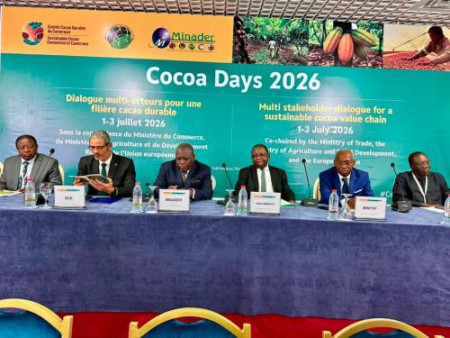
Speaking at the Cocoa Days event in Yaoundé on July 2, 2026, Minister Luc Magloire Mbarga Atangana highlighted the growing disconnect between stringent sustainability demands and the economic realities faced by Cameroonian farmers. He noted that farmgate cocoa prices have plummeted from as high as CFA5,000 per kilogram in recent marketing seasons to between CFA1,800 and CFA2,000 per kilogram. These reduced prices, he stated, are now insufficient to cover the augmented expenses associated with regulatory compliance, farm inputs, and labour. “The feeling among producers is that they are constantly being asked to do more without receiving anything in return,” Mbarga Atangana remarked, underscoring the vulnerability of smallholder farmers within the cocoa value chain.
While Cameroon affirms its commitment to sustainability, the government questions the equitable distribution of the financial burden associated with this transition. The European Union Deforestation Regulation (EUDR), which mandates that companies placing products on the EU market prove their origin from non-deforested land after December 31, 2020, and compliance with producing country laws, is already reshaping supply chains. Although full implementation is staggered, with large and medium-sized companies facing a December 30, 2026 deadline and micro and small businesses until June 30, 2027, the regulation’s anticipatory effects are palpable. Exporters, buyers, and processors are increasingly demanding granular data on cocoa origin, farm geolocation, and adherence to environmental, social, and legal standards, making market access contingent on meeting these stringent traceability requirements.
Minister Mbarga Atangana clarified that Cameroon does not oppose the environmental objectives underpinning the EUDR. “I have no intention of questioning the deforestation regulation, which serves the noble cause of protecting the environment. Our producers have complied with it, sometimes reluctantly,” he stated. However, he stressed the imperative for farmers to receive a fair return for the additional costs incurred. The minister articulated a clear demand for transparency regarding the benefits producers will receive in exchange for their compliance efforts, asserting that sustainability must be intrinsically linked with profitability, fair pricing, equitable compensation, and enhanced market transparency. This stance reflects a broader concern among producing nations that the onus of sustainability compliance should not fall solely on farmers without a corresponding improvement in their income levels.
The current market prices, according to the minister, render farmers incapable of absorbing the increased costs associated with the EUDR. Meeting the regulation’s stipulations necessitates a shift towards more intensive farming practices on existing land to avoid deforestation, which in turn requires higher yields, improved agricultural techniques, and greater use of fertilisers and crop protection products – all contributing to elevated production costs. Martin Kamdjeu, chairman of an agricultural cooperative and a cocoa farmer in Nkondjock, elaborated on this challenge: “We are now expected to move from extensive farming to more intensive agriculture to avoid deforestation. That means using chemical inputs that many farmers cannot afford. In the past, we relied on more traditional farming methods.”

Furthermore, labour costs have escalated significantly. Producers report that the surge in cocoa prices during previous seasons incentivised many farm workers to establish their own plantations, leading to a scarcity of available labour. Hortense Nguele, regional president of the National Association of Cocoa and Coffee Producers, noted, “Some farm workers became cocoa producers themselves after prices increased. As a result, labour has become scarce and much more expensive. Today, you cannot hire a worker for less than CFA40,000, compared with CFA25,000 just a few years ago.”
This situation has reignited a long-standing debate regarding the equitable distribution of value across the cocoa supply chain, with some producers contending that major international cocoa buyers are safeguarding their profit margins by shifting the burden of compliance costs onto farmers. The European Union maintains that the regulation is designed to mitigate the environmental impact of European consumption on global deforestation and ensure that imported products do not contribute to forest loss. Cameroon, while not disputing this objective, argues that the transition will be unsustainable unless farmers are assured of fair prices, robust financial support, and a more transparent market. The critical challenge for Cameroon’s cocoa sector lies in preserving access to the European market while ensuring that the costs of meeting new environmental standards do not further erode farmers’ incomes.