






DSS Asks Court To Foreclose Sowore’s Defence In Cyberbullying Trial, Cites Abuse Of Court Process

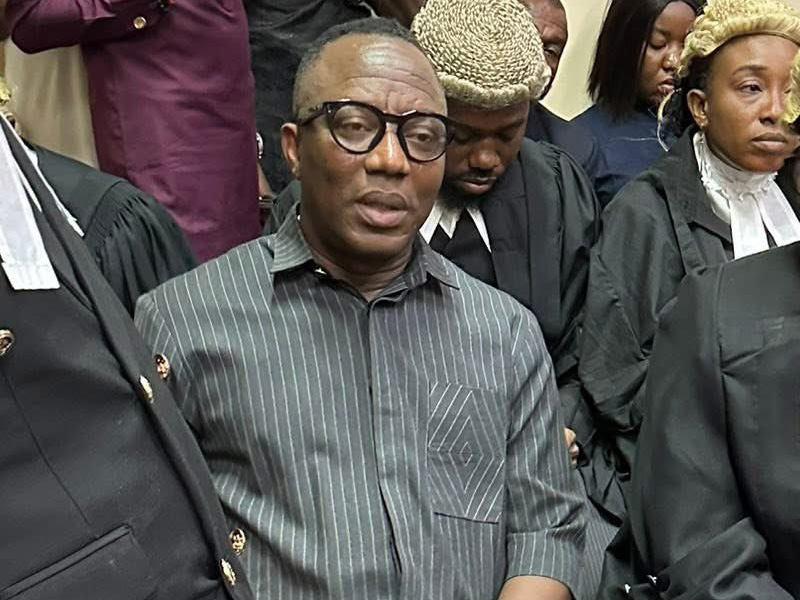

The Department of State Services (DSS) on Tuesday told a Federal High Court sitting in Abuja to make an order foreclosing the defence of the presidential candidate of the African Action Congress (AAC), Omoyele Sowore, in his ongoing trial for alleged cyberbullying of President Bola Tinubu.
Counsel to the DSS, Akinlolu Kehinde, SAN, informed the trial judge, Justice Mohammed Umar, shortly before adjournment, that an application had been filed to that effect and that Sowore’s legal team had already been served with the application.
The senior lawyer, who submitted that Sowore had exceeded by nine the five adjournments he was entitled to in a criminal trial, said there must be an end to this.
“Before we finally draw the curtain to the proceedings, I want to bring to your lordship notice the application we filed and and served on the defendant.
“The application is that, there must be an end to all these. The defendant has since exceeded the number of adjournments as required by law,” he said, and urged the court to allow the application to be taken.
In the motion on notice filed on November 23,2026 by Kehinde, the DSS sought an order closing the case for the defence, as well as an order directing the parties to file and exchange their final written addresses within such time as the court shall direct, and fixing a date for the adoption of the addresses.
Giving nine grounds of argument, the lawyer said Sowore was re-arraigned on a two-count charge, to which he pleaded not guilty on January 19, 2026, after which the trial commenced, with the DSS calling its witness and closing its case in March 2026. The defendant’s no-case submission was overruled on May 8, 2026, and he was called upon to enter his defence.
The lawyer said Sowore, as particularised in the affidavit in support of the motion, sought or procured an adjournment of the proceedings on at least 14 occasions.
He said eight of the adjournments had been sought since he was called upon to enter his defence.
“This is far in excess of the five adjournments to which a party is entitled under Section 396(4) of the Administration of Criminal Justice Act, 2015. Since the defendant/respondent opened his defence on 6th July 2026, the trial has not progressed beyond the evidence of two defence witnesses,” he said.
Kehinde said Sowore had repeatedly filed applications and processes that had the effect of stalling the trial, including the subpoena issued against him (the lead counsel to the complainant/applicant).
He said the court had, on several occasions, warned Sowore against further delay, adding that the right to fair hearing guaranteed by Section 36 of the Constitution was a right to an opportunity to be heard, not a right to an unlimited number of adjournments.
He argued that a defendant who had been afforded ample opportunity to present his defence and failed to use it could not complain of a breach of that right.
“Section 36(4) of the Constitution guarantees a fair hearing within a reasonable time, and the Administration of Criminal Justice Act, 2015 requires that criminal trials proceed from day to day or, where that is impracticable, within the strict limits on adjournments prescribed by Section 396 of the ACJA”,
Kehinde said, and urged the court to grant the application in the interest of justice.
Responding, Reuben Adakole, who appeared for Sowore, acknowledged receipt of the application seeking to foreclose their defence.
Adakole, however, said that before the prosecution’s application could be taken, the court needed to deliver its ruling on the objection raised by Prof. Joash Amupitan, SAN, the Independent National Electoral Commission (INEC) Chairman, against their subpoena, including their preliminary objection and ex-parte motion.
“In as much as the application tends to foreclose us, there is our application which the court ought to pronounce on first. Until after the ruling, we can look at it. The application is unripe my lord,” he said.
Kehinde, however, corrected Adakole’s impression that the prosecution’s request was to get a date to hear the application seeking the foreclosure of Sowore’s defence.
Adakole also sought a hearing date for their applications for substituted service, which he said were filed before the prosecution’s motion.
Justice Umar subsequently adjourned the matter till December 7,2026 for ruling on Amupitan’s motion seeking to set aside Sowore’s subpoena.
The judge also fixed a date for the hearing of the DSS’s application seeking to foreclose Sowore’s defence and for other pending applications.
Earlier, when the case was called on Tuesday, Alex Iziyon, SAN, who represented Prof. Amupitan, informed the court that the matter had been adjourned on Monday because the defence could not file their counter-affidavit.
He said the defence had finally filed and that he had also responded, and prayed the court for the parties to adopt their processes.
Responding, Adakole also admitted that processes had been exchanged by the parties, but said that the subpoena directed at the INEC chairman was strictly a “Duces Tecum.”
According to him, there was a need to correct that impression, explaining that Sowore was not really asking Amupitan to come to court and testify.
“It is just strictly to come and tender the documents and that was why we filed a motion to amend the application.
“We ask that we be allowed to move our motion ex-parte, so that it will lay to rest all these issues. So the intent was just for INEC chairman to tender the documents and not to testify,” he restated.

But Iziyon disagreed with Adakole’s submission and said: “The defendant cannot take this court for a ride. I submit with all sense of responsibility and reminded that the court had earlier directed the defence to put them on notice by formally filing their application so that they could respond appropriately.
“Now counsel is asking that he wants to move the motion ex-parte,” he said, arguing that issues had already been joined.
Justice Umar then told Adakole to do the needful since issues had been joined.
“Before the last adjourned date, I told you that since you have issued that subpoena and they have been joined, anything you want to do now will be by motion on notice; serve them and they will respond,” the judge said.
Adakole, therefore, prayed that all the applications be taken together, and the court asked him to go ahead.
Adopting his processes, Iziyon said INEC had filed three processes and enumerated all of them in urging the court to set aside the subpoena.
He relied on Justice Umar’s earlier ruling on the power of the court to set aside a subpoena.
Iziyon also cited a previous case in which a subpoena was set aside because the case had no bearing on the person sought to be subpoenaed.
“I want my lord to take a closer loook at our points as issues have been joined, and if an amendment will be made, you have to apply to court. It is to guard against this that this pronouncement was made by your learned brothers. We urge your lordship to set it aside,” he prayed.
Adakole equally adopted all their processes and relied on them in urging the court to dismiss Amupitan’s motion.
He also moved the ex-parte motion filed on November 11, 2026 which sought four prayers.
The lawyer explained that the application in question was directed at a public officer who has custody of public documents that the defendant required to use in his defence.
He argued that the said documents could only be said to be relevant or irrelevant by the court upon production. “It is not for the applicant to say so. That will be preemptive,” he said.
After listening to the parties, Justice Umar adjourned the matter till December 7, 2026, for ruling.