







Court of Appeal Upholds NCC Authority, Dismisses COSON’s Interlocutory Appeal

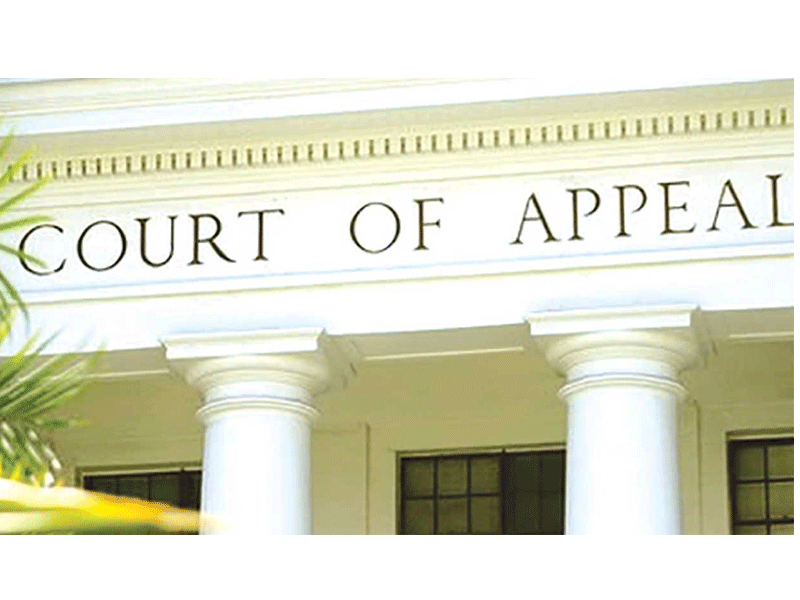

The Court of Appeal, Lagos Division, has dismissed an interlocutory appeal filed by the Copyright Society of Nigeria Ltd/Gte (COSON) against the Nigerian Copyright Commission (NCC), thereby affirming the earlier decision of the Federal High Court which refused to grant an injunction restraining the Commission.
In a unanimous judgment delivered on 9 July 2026, the three‑member panel led by Justice Polycarp Terna Kwahar, with Justices Folasade Ayodeji Ojo and Muslim Sule Hassan concurring, awarded ₦200,000 costs against COSON.
COSON had instituted a substantive suit challenging aspects of the Copyright (Collective Management Organisations) Regulations, 2007.
Pending determination of the case, COSON sought an interlocutory injunction to restrain the NCC from revoking its operating approval or interfering with its management, finances, bank accounts, audits, and royalty collection.
However, the Federal High Court, in a ruling delivered on December 1, 2021, declined the application, holding that an interlocutory injunction cannot be granted to restrain an action that had already been completed.
The court noted that COSON’s operating approval had been suspended by the NCC in April 2018 and subsequently expired in May 2019, before the substantive suit and the application for injunction were filed.
In affirming the lower court’s decision, the Court of Appeal ruled that the legal status existing before the commencement of the suit was that COSON’s operating approval had already become inoperative.
Justice Kwahar, in the lead judgment, stated: “Both the Appellant and the Respondent have demonstrated vide their affidavit evidence that the Appellant’s operation had prior to the commencement of the suit become inoperative by virtue of the suspension of the Appellant’s licence and expiration by effluxion of time. That is the status quo ante bellum before the commencement of the suit at the lower Court.”
The appellate court emphasized that the purpose of an interlocutory injunction is to preserve the status quo pending the determination of a substantive case, not to reverse actions that had already taken effect before litigation commenced.
It therefore held that granting the relief sought by COSON would have altered, rather than preserved, the existing legal position, and consequently dismissed the appeal for lacking merit.
Reacting to the judgment, the Nigerian Copyright Commission described the ruling as a reaffirmation of its position that there was no subsisting operating approval for the court to preserve through an injunction.
The Commission further reiterated that COSON is currently not approved to operate as a Collective Management Organisation (CMO) in Nigeria.
The judgment is regarded as a significant legal victory for the NCC, reinforcing the Commission’s regulatory authority over collective management organisations and clarifying the legal limits of interlocutory injunctions in disputes involving expired or suspended regulatory approvals.