









Arizona Sonora Copper: Navigating Sustainability, Regulatory Compliance, and Agricultural Interdependence


The Arizona Sonora region, a critical hub for over 60% of the United States’ copper supply, stands at a vital intersection of resource extraction and environmental stewardship. This extensive mining activity profoundly influences agricultural viability, forestry health, and regional infrastructure. As modern Arizona Sonora copper mining projects increasingly prioritise sustainable practices, a nuanced understanding of land, water, soil, and habitat management becomes paramount for long-term environmental and economic prosperity. This analysis, drawing from insights into Robson’s Arizona Mining World, underscores the intricate balance required to ensure both the economic promise of copper extraction and the enduring health of Arizona’s natural resources.
Copper’s indispensable role in global supply chains, electronics, renewable energy technologies, and infrastructure development positions Arizona Sonora as a linchpin in sustainable global progress. However, mining operations in these semi-arid and arid landscapes inherently create direct and indirect impact pathways. These include the management of tailings and waste, significant water withdrawals, and land-use transformations, all of which necessitate responsible and legally compliant navigation. This examination delves into the multi-layered sustainability landscape, where watershed health, crop productivity, and ecosystem integrity are not mutually exclusive but deeply interconnected. Modern Arizona Sonora copper mining is increasingly employing integrated environmental management, advanced water technologies, soil and habitat-focused restoration, and cutting-edge remote sensing to ensure both economic viability and the long-term health of the region’s agricultural and ecological systems.
Arizona Sonora copper mining projects are actively embracing evolving environmental and technical standards, with a strong emphasis on integrated management strategies designed to deliver resource extraction while minimising environmental disruption. Robson’s Arizona mining world is characterised by a spectrum of sustainability initiatives and a careful consideration of the region’s unique natural features. Key sustainable practices include the adoption of efficient, low-impact ore extraction and beneficiation methods that minimise waste and runoff. Furthermore, the design and operation of tailings facilities are focused on preventing leachate and heavy metal runoff that could contaminate nearby farmlands and waterways. Strategic mine siting and alignment with local crop patterns, irrigation cycles, and forestry corridors are also crucial for minimising disruption to soil fertility and landscape structure. Integrated watershed management, involving collaborative water planning between mine operators and agricultural water users, ensures that resource withdrawals are aligned with irrigation needs, and that return flows adequately support downstream crop production. Proactive reclamation and habitat support, employing native, drought-tolerant vegetation for soil stabilisation, erosion control, and biodiversity enhancement, are also central to these efforts.
A significant insight from the Arizona Sonora region indicates that aligning mine activities with crop cycles and irrigation patterns in copper projects can reduce soil structure disruption by over 25%, thereby supporting enhanced farmland productivity.
The processes of copper ore extraction and initial beneficiation, while critical for resource generation, inherently produce substantial volumes of waste. Tailings, the finely ground residue left after ore processing, and waste rock pose a risk of leaching heavy metals, potentially impacting nearby soils and water bodies. Properly managed tailings facilities are designed to prevent harmful leachate through the use of liners, comprehensive monitoring, and effective cover systems. These facilities are also designed with contoured piles to minimise erosion and facilitate future reclamation. Establishing vegetative cover on these sites is essential for dust suppression and moisture retention, and prioritising locations that avoid direct proximity to agricultural lands and riparian zones is a key consideration. Collaborative planning between mine operators and farming communities ensures that waste management practices are not only compliant with environmental regulations but also deeply protective of agricultural health and ecosystem function.
A proactive measure in Robson’s Arizona mining world involves the preservation of riparian and buffer zones between mining areas and agricultural or forestry land. These zones serve as critical natural filters, reducing the risk of heavy metal runoff, promoting water infiltration, and providing vital habitat corridors for native species. Best practices in this regard include establishing cover crops and vegetative stabilisation on all disturbed or exposed lands to prevent erosion and dust. Creating buffer strips along waterways and irrigation canals shields aquatic systems from contaminated runoff. Restoring landscape contours through re-grading and native planting, mimicking natural watershed patterns, optimises resilience and fertility. Modern reclamation planning extends beyond mere visual restoration, aiming to functionally align post-mining land use with local agricultural and forestry needs.
Efficient water management is a pivotal concern in the arid and semi-arid regions of Arizona Sonora, where both mining facilities and agricultural operations draw from finite aquifer and river systems. Copper mining operations require substantial water volumes for ore processing, dust suppression, and cooling mining equipment. Concurrently, local agriculture critically depends on these same water sources for irrigation and crop health. The achievable balance between mining and agriculture hinges on the effective implementation of water recycling, advanced treatment technologies, and collaborative watershed management. By reducing fresh-water withdrawals and maintaining the viability of return flows for downstream users, Arizona Sonora copper mines can support both sustainable extraction and agricultural productivity.
The imperative for efficient water management in Arizona Sonora copper mining has been shown to reduce agricultural soil impact by up to 40%. Water scarcity is a significant driver of technological innovation within Arizona Sonora copper operations. Mines that prioritise water recycling and employ smart release timing often achieve higher ESG ratings and foster improved regional relations, thereby enhancing long-term asset value.
Key water stewardship practices in Arizona Sonora copper mining include the deployment of high-efficiency recycling systems to reduce withdrawals from aquifers and rivers. Real-time water quality monitoring is essential for continuous testing and adjustment of management strategies to avoid contamination and protect crop irrigation viability. The use of phytoremediation wetlands, employing constructed wetlands and plant-based treatment to filter heavy metals, serves a dual purpose for both mining runoff management and wildlife habitat creation. Coordinated release regimes, timing water outflows from mine sites with local farmers’ irrigation cycles and downstream canal needs, are also crucial. Furthermore, integrated watershed planning that aligns mine siting, waste management, and water infrastructure with comprehensive watershed models promotes sustainable supply and landscape resilience.
Constructed wetlands and plant-based remediation are increasingly adopted across Arizona Sonora copper operations, particularly in areas proximate to agricultural zones. These systems effectively treat mine runoff, trapping sediments and immobilising heavy metals before water reaches canals or fields. They also create habitat corridors for birds and pollinators, benefiting both reforestation efforts and crop yields, while providing biomass and carbon sequestration to support broader environmental health objectives.

The proximity of mines, tailings, and processing plants significantly influences local soil health, agricultural productivity, and even microclimate conditions. Copper extraction and beneficiation generate waste rock and fine tailings that, if not meticulously managed, can lead to soil contamination, disrupt soil structure, and erode organic fertility on nearby farmlands. Modern Arizona Sonora copper operations are therefore emphasising proactive soil stewardship practices. These include vegetative stabilisation using native, drought-tolerant cover for erosion control and nutrient cycling; contour pit management involving re-grading mines and dumps to align with natural water flow, thereby minimising runoff onto fields; and ongoing geochemical soil monitoring to detect and remediate heavy metal buildup. Post-mining cover cropping is employed to build organic matter and protect soil structure during reclamation, and buffer zone establishment is critical for preventing soil and water contamination.
The most effective results are achieved when operations integrate soil health as a key performance indicator across all mine project phases. Real-time data, often derived from satellite-based mineral detection, enables early intervention and precision soil mapping, which is critical for Arizona Sonora copper management. A common oversight is the inadequate design of buffer zones between tailings and irrigated fields, which risks a permanent reduction in soil productivity. Soil fertility enhancements achieved through reclamation can support future crop or pasture use post-mining, provided they are managed from the outset. Integrated soil and water monitoring should continue for decades following mine closure to ensure enduring agricultural benefits.
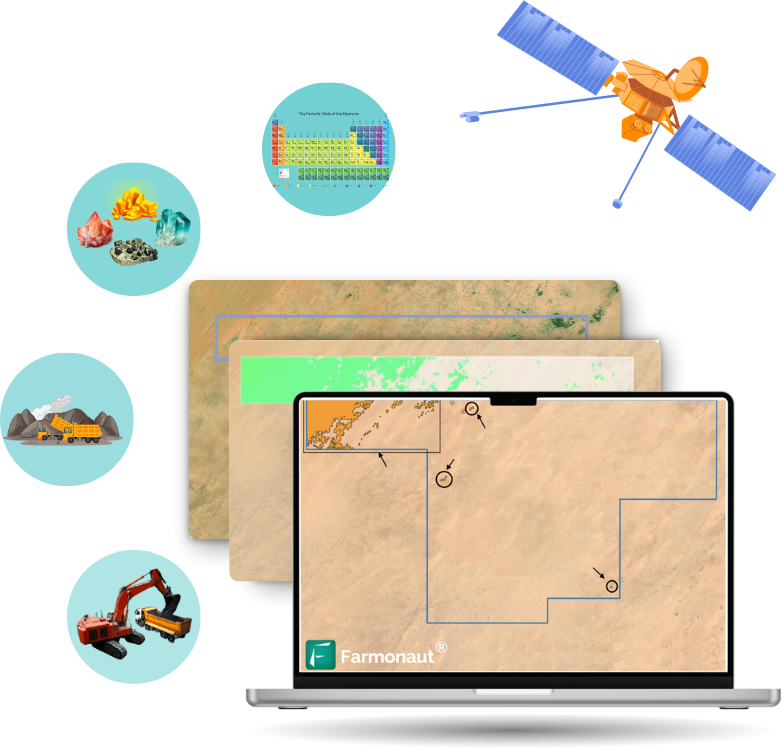
Farmonaut’s platform enables mining operators to remotely monitor, assess, and protect soil health by providing satellite-driven geochemical and vegetative analysis. Their Earth observation platform identifies mineralised zones and alteration halos, assisting in aligning mine siting with agricultural and habitat priorities. It maps real-time soil changes associated with mining and restoration activities and supports objective reclamation auditing, reinforcing responsible stewardship across the Arizona Sonora landscape.
Effective reclamation of mined landscapes in the Robson Arizona Sonora copper world is central to both biodiversity resilience and downstream agricultural benefit. Restoration efforts focus not merely on aesthetics but on stabilising soils and slopes to reduce erosion and sediment movement, re-establishing native species for long-term ecosystem health, and providing functional habitat corridors for wildlife, birds, and beneficial insects. These efforts also aim to create windbreaks and microclimate regulation zones that moderate temperatures and improve crop viability on adjacent farmland. Post-mining lands may be restored as forest plantations, agroforestry buffers, or mixed-use pasture, depending on local planning and stakeholder input. The selection of drought-adapted and native plants maximises carbon sequestration, water infiltration, and soil organic matter, delivering tangible climate and agricultural benefits. Windbreaks, comprising trees and shrubs, effectively block hot desert winds, supporting adjacent crops by reducing moisture loss and frost risk, while also providing essential habitat.