









Nigerian Bar Association Partners UNICEF to Expand Pro Bono Legal Services for Children

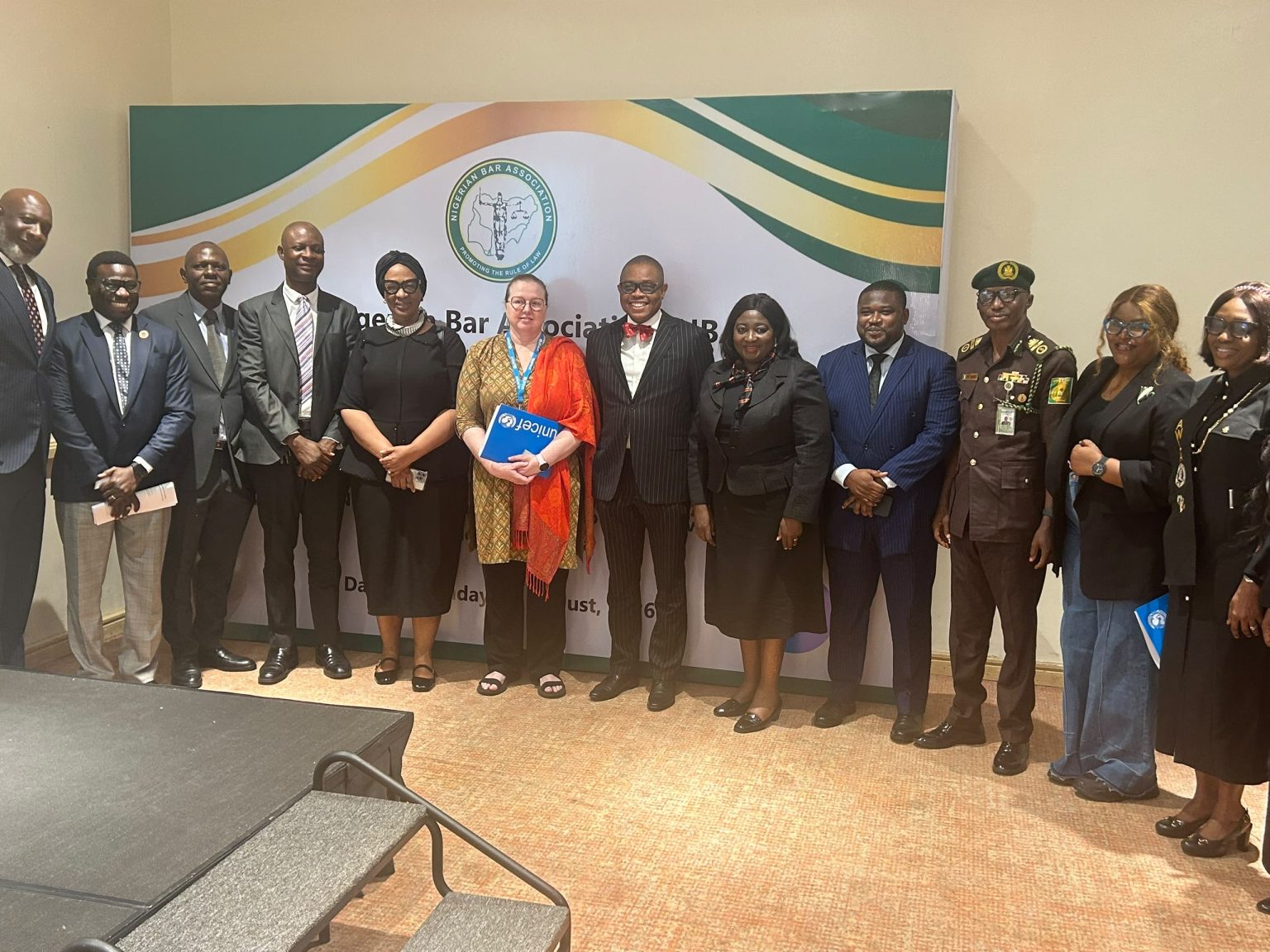

The Nigerian Bar Association (NBA), in collaboration with the United Nations Children’s Fund (UNICEF), has taken a significant step towards strengthening access to justice for children in Nigeria with the launch of a strategic partnership aimed at expanding pro bono legal services for vulnerable children across the country. The stakeholders’ meeting, held on Monday, 10 August 2026, brought together key actors in Nigeria’s justice sector, legal profession, and child protection community to develop a coordinated framework that will ensure no child is denied justice because of poverty or lack of legal representation.
The event commenced at about 10:30 a.m. with the rendition of the Nigerian National Anthem, followed by a safety briefing by the hotel’s Safety Manager, who assured participants of adequate security throughout the programme. The formal opening attracted representatives from the Federal Ministry of Justice, UNICEF, the Nigerian Bar Association, the Nigerian Law School, the Legal Aid Council of Nigeria, the Nigerian Correctional Service, and several other stakeholders committed to advancing the rights and welfare of children.
Delivering the opening remarks, the NBA President, Mazi Afam Osigwe, SAN described the collaboration as a landmark initiative that reflects the legal profession’s commitment to protecting the rights and dignity of every Nigerian child. He stated that access to justice is one of the most important safeguards for children and noted that many children continue to suffer injustice simply because they cannot afford legal representation.
“Today, I invite each of us to move beyond commitment and towards action,” Osigwe, SAN said.
The NBA President explained that lawyers have a professional and moral responsibility to protect the vulnerable, particularly children who often have no voice within the justice system. He called on lawyers, law firms, NBA branches, and especially young lawyers to embrace pro bono legal services for children, stressing that such services should not be viewed merely as acts of charity but as a professional duty aimed at ensuring justice is available to every child, regardless of social or economic status.
“To the Nigerian Bar Association, we look to your leadership in mobilizing lawyers in every branch of the federation to champion pro bono legal representation for children and to make child justice an integral part of professional practice. Just imagine if every practicing lawyer in each NBA branch handles a case pro bono on behalf of one child every year in Nigeria.”
According to Osigwe, the NBA’s partnership with UNICEF will provide an organised platform for mobilising legal practitioners across Nigeria to represent children free of charge whenever the need arises. He commended UNICEF for its unwavering commitment to child protection and also acknowledged the continuous support of the Federal Ministry of Justice in promoting justice sector reforms affecting children.
“To the judiciary, we encourage the continued promotion of child-sensitive procedures that place the rights, dignity, and best interests of children at the centre of justice delivery. Just imagine what it would mean to justice for children if the Chief Judge of every State issues a Practice Direction to judicial officers in the state, requiring mandatory age determination and consideration of diversion measures if a child is brought before them for arraignment. Imagine.
“To the Legal Aid Council of Nigeria, law enforcement agencies, correctional services, and social welfare authorities,” Osigwe continued, “we urge you to strengthen coordination mechanisms, referral systems, and multidisciplinary approaches that ensure children receive comprehensive support throughout their engagement with the justice system.”
“To government ministries and policymakers, we call for sustained investment in child justice reforms, implementation of child rights legislation, and the allocation of resources necessary to ensure that child-friendly justice services reach every part of the country.
To development partners, civil society organizations, academic institutions, and the media, we ask for your support in generating evidence, raising awareness, strengthening accountability, and promoting a national culture that places children’s rights at the forefront of justice sector reforms.”
“Above all, let us unite around a common vision: a Nigeria where no child faces the justice system alone; where every child has access to competent legal representation; where detention is truly a measure of last resort; and where every child can count on a justice system that protects rather than harms, rehabilitates rather than stigmatizes, and empowers rather than excludes. The success of this partnership will not be measured by today’s launch. It will be measured by the child who is reunited with family instead of remaining unnecessarily detained; the survivor who receives justice and protection; and the young person who is given a second chance through rehabilitation and reintegration rather than a lifetime of exclusion.
Let today’s gathering be remembered as the moment when we collectively committed to turning those aspirations into reality,” Osigwe, SAN added in his emotion-laden speech.
Speaking on behalf of UNICEF, the organisation’s representative described the partnership as a major milestone in protecting the rights of Nigerian children. She observed that many children remain in detention facilities or become involved in legal proceedings without access to lawyers because their families cannot afford legal representation. Such circumstances, she noted, expose children to further violations of their rights and deny them fair treatment under the law.
She explained that UNICEF believes justice is an essential component of child protection and that every child deserves equal access to legal services irrespective of financial circumstances. Through the collaboration with the NBA, UNICEF expressed confidence that qualified lawyers across the country would now be mobilised to provide free legal representation to children who require legal assistance.
The UNICEF representative also advocated broader justice sector reforms to strengthen child-friendly legal procedures in Nigeria. She maintained that justice systems should recognise the unique needs of children and ensure that legal processes promote rehabilitation, protection, and reintegration rather than punishment alone.
Representing the Attorney-General of the Federation and Minister of Justice, an official from the Federal Ministry of Justice formally declared the stakeholders’ meeting open. She emphasised that access to justice is not a privilege but a fundamental right guaranteed to every Nigerian child. She disclosed that under the Ministry’s “Justice for Children” initiative, the Federal Government has continued to implement policies aimed at improving child protection across the country.
She further revealed that efforts are already underway to amend the Child Rights Act, noting that a committee has been constituted to review the legislation with a view to strengthening existing protections for children. According to her, while several legal frameworks already exist, the greatest challenge has been translating those laws into practical results through effective implementation and stronger institutional collaboration.
The representative of the Director-General of the Nigerian Law School welcomed the initiative and reaffirmed the institution’s commitment to promoting pro bono culture among future legal practitioners. She disclosed that the Nigerian Law School has continued to sensitise students on the importance of free legal services as part of their professional responsibility and ethical obligations. She expressed optimism that the NBA-UNICEF partnership would further inspire young lawyers to dedicate part of their practice to serving vulnerable members of society.
The representative of the Legal Aid Council of Nigeria equally commended the partnership and encouraged the NBA to establish a comprehensive database of lawyers willing to provide pro bono services. He assured participants that the Legal Aid Council stands ready to collaborate fully with the NBA in implementing the initiative. However, he cautioned that many well-intentioned programmes have failed because of weak implementation and urged all stakeholders to ensure that the partnership produces measurable results.

The Nigerian Correctional Service also welcomed the initiative, describing it as timely and necessary. Its representative noted that many children currently in custodial centres require legal assistance and appealed to the NBA to ensure that the programme reaches every part of the country. He stressed that extending pro bono services nationwide would significantly improve access to justice for disadvantaged children.
The interactive session that followed generated robust discussions among participants on practical challenges confronting child justice administration in Nigeria. Several speakers observed that legal representation alone cannot solve all the problems affecting children within the justice system. Participants stressed the need to prevent children from unnecessarily entering the criminal justice system by properly determining their ages before arraignment, detention, or prosecution.
One participant recommended that lawyers handling children’s cases should ensure that authentic birth certificates or other reliable age verification documents are obtained and presented before the courts whenever age becomes an issue. This, participants noted, would reduce the risk of minors being treated as adults during criminal proceedings.
Another participant raised concerns over the absence of juvenile courts and juvenile correctional facilities within the Federal Capital Territory, Abuja. According to the speaker, the lack of specialised institutions undermines efforts to deliver child-friendly justice and requires urgent government intervention.
Questions were also raised regarding the application of the constitutional principle of presumption of innocence, with participants urging prosecutors and law enforcement agencies to ensure that children are not subjected to unnecessary detention before their cases are determined. Others advocated greater use of diversion programmes and community service for children who commit minor offences rather than exposing them to prolonged detention.
Responding to the contributions, the NBA President reiterated that children should never be treated as miniature adults within the justice system. He called for stronger rehabilitation programmes designed to address the root causes of juvenile offending while reducing the likelihood of repeat offences. According to him, protecting children requires more than courtroom representation; it demands preventive measures, education, family support, and effective rehabilitation.
He further emphasised that responsibility for ensuring access to justice for children cannot rest solely on the Federal Government. He urged state governments to actively establish child-friendly institutions, strengthen child protection mechanisms, and invest in programmes that guarantee equal access to justice across all states of the federation.
The meeting concluded with a vote of thanks, during which participants reaffirmed their commitment to making the NBA-UNICEF partnership a practical and enduring initiative capable of transforming access to justice for children in Nigeria. Stakeholders expressed optimism that the collaboration would not only expand pro bono legal representation but also drive meaningful reforms that place the rights, welfare, and best interests of every Nigerian child at the centre of the country’s justice system.