








Nigeria Customs Intensifies Green Tax Awareness Amidst Fiscal Adjustments and Stakeholder Engagement


The Nigeria Customs Service (NCS) has significantly ramped up its nationwide sensitisation campaign concerning the impending implementation of the Green Tax Surcharge and associated fiscal adjustments, scheduled to take effect on July 1, 2026. This proactive initiative underscores the federal government’s commitment to environmental sustainability, carbon emission reduction, and the promotion of cleaner vehicle imports, aligning Nigeria with global environmental standards.
The NCS disclosed this strategic push in a recent statement, highlighting that the campaign aims to ensure all stakeholders are thoroughly informed and prepared for the policy’s commencement. The initiative is designed to foster a clear understanding of the new regulations, thereby promoting voluntary compliance and ensuring a uniform application across all customs commands.
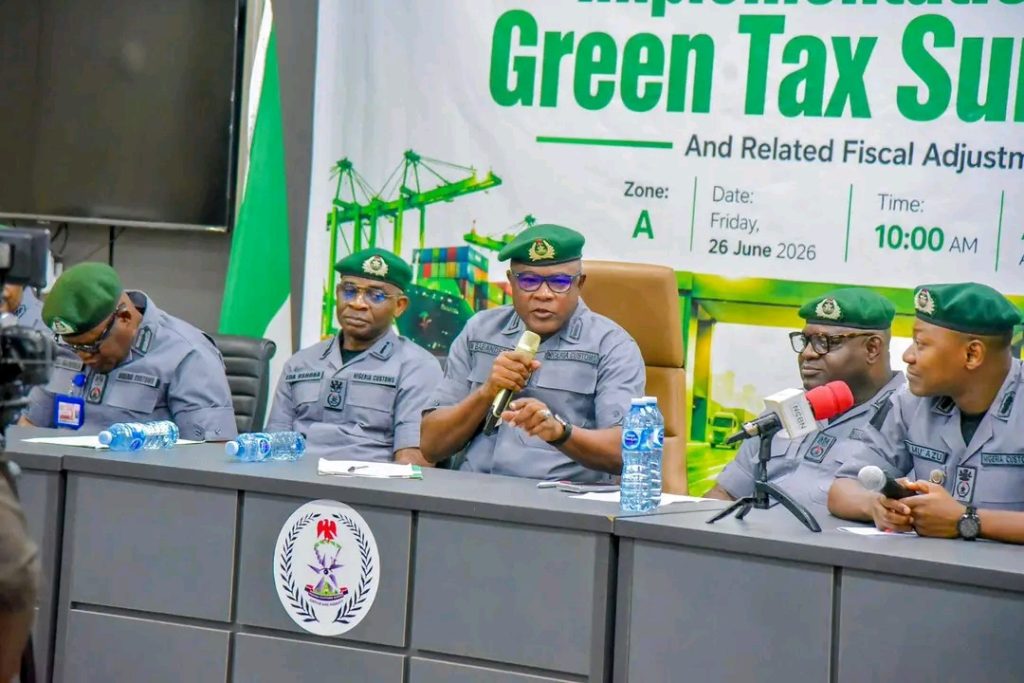
A key sensitisation programme, held at the Apapa Area Command on Friday, June 26, 2026, under the theme “Implementation of the Green Tax Surcharge and Related Fiscal Adjustments,” convened customs officers, licensed agents, freight forwarders, importers, and other critical industry players. Representing the Comptroller-General of Customs, Mr Adewale Adeniyi, the Zonal Coordinator for Zone A, Mr Mohammed Babadende, emphasised the exercise’s objective: to eliminate uncertainty and guarantee a seamless rollout.
During the event, Mr Murtala Muazu, Comptroller in charge of Tariff, System Audit and Coordination, provided a technical overview, explaining that the Green Tax Surcharge necessitates a distinct assessment process from conventional fiscal measures. To streamline compliance, the NCS has introduced a simplified mechanism via the Harmonised System (HS) Code declaration platform.
Crucially, the federal government has simultaneously implemented a review of existing import charges on vehicles to mitigate the impact of the new environmental levy. Import levies on new vehicles have been reduced from 20 per cent to 10 per cent, while duties on used vehicles have been cut from 15 per cent to five per cent. These reductions are intended to offset the Green Tax Surcharge, support legitimate trade, and prevent undue burdens on businesses.
Area Controllers present at the sensitisation urged stakeholders to support the initiative, noting that the reduced import levies would lower the cost of doing business and contribute to reduced transportation costs nationwide. While stakeholders welcomed the policy, they called for sustained public awareness campaigns to ensure broad understanding and encourage voluntary compliance as the July 1 deadline approaches. The Green Tax Surcharge is a pivotal component of the federal government’s broader strategy to promote environmentally friendly transportation and align Nigeria’s import policies with international climate and sustainability objectives.
Separately, the Centre for the Promotion of Private Enterprise (CPPE) has issued a cautionary note regarding the Senate’s recent resolution to ban textile fabric imports. The CPPE argues that such a prohibition, intended to revive Nigeria’s textile sector, could prove counterproductive, potentially undermining related industries and jeopardising millions of jobs.
Mr Muda Yusuf, Chief Executive of the CPPE, acknowledged the commendable objective of revitalising the textile industry but warned that an outright import ban would likely exacerbate economic challenges. He pointed out that the primary drivers of the textile sector’s decline are structural issues such as high energy costs, inadequate infrastructure, expensive credit, obsolete technology, logistics bottlenecks, smuggling, and policy inconsistency, rather than import competition.
The CPPE highlighted that restricting textile imports would disrupt production across the garment, fashion, tailoring, furniture, and interior design industries, which rely heavily on imported fabrics as essential production inputs. Nigeria’s fashion and garment sector, valued at approximately N10 trillion and supporting an estimated 10 million livelihoods, generates significant domestic value addition through design, tailoring, and branding. An import ban would increase production costs, limit consumer choice, and threaten thousands of micro, small, and medium enterprises. Similarly, the furniture and interior design industry, valued at about N7 trillion, would face supply disruptions, weakening manufacturers’ competitiveness.

The CPPE noted that imported textile fabrics already face a combined Import Duty and Import Adjustment Tax of 35 per cent to 45 per cent, yet this existing tariff protection has not restored the competitiveness of local manufacturers. Mr Yusuf stressed that the core problem lies in production economics, not import penetration, and an import ban would address symptoms while leaving underlying causes unresolved. He further stated that local manufacturers currently lack the capacity to meet the quantity, quality, and diversity of fabrics required by downstream industries, warning that an outright ban could lead to supply shortages and negatively impact employment-generating sectors.
The CPPE advocates for a comprehensive value-chain strategy, including improved security, mechanisation, better seedlings, and guaranteed off-take arrangements for domestic cotton production. Recommendations also include affordable long-term financing, access to modern technology, reliable energy supply, and a more competitive operating environment. The CPPE further proposed prioritising locally produced textiles for uniforms in public institutions and establishing a Textile Competitiveness Fund. Strengthening border enforcement to curb smuggling and implementing reforms to reduce energy and financing costs are also recommended. The CPPE concluded that sustainable revival hinges on improving competitiveness rather than imposing additional import restrictions, warning that a blanket ban could encourage smuggling, reduce customs revenue, and weaken a broader value chain crucial for employment and economic growth.
In a significant development for Nigeria’s downstream petroleum sector, Pathway Advisors Limited has announced its role as Lead Issuing House for a N300 billion Commercial Paper Programme for Pivot Integrated Energy Services Limited. This transaction marks a substantial mobilisation of short-term capital for the energy sector.
The programme documentation was formally executed in Lagos, following the completion of all regulatory and clearance processes. Mr Adekunle Alade, Chief Executive of Pathway Advisors Limited, underscored the strategic importance of this Commercial Paper issuance in financing working capital, enabling high-growth energy businesses to scale efficiently. He highlighted the profound transformation occurring in Nigeria’s downstream energy sector, driven by subsidy removal, emerging domestic refining capacity, and rising demand across West Africa. Mr Alade stated that companies like Pivot Integrated Energy Services Limited, with their vertically integrated models and strong track records, are precisely the kind of issuers that capital markets should be financing, providing access to a deep pool of institutional investors.