






Did the Federal Court of Canada Determine that PDP or APC Are Terrorist Organisations? By Adekola Olawoye

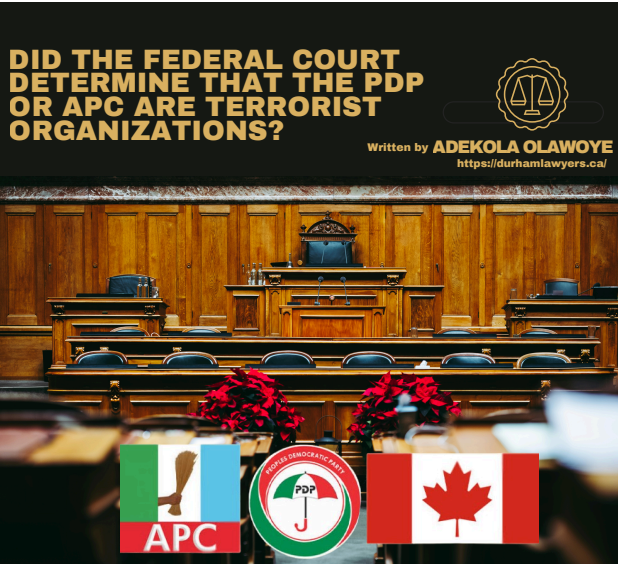

Recently, the Federal Court of Canada, while deciding an Application for Judicial Review filed by Douglas Egharevba, upheld the decision of the Immigration Appeal Division (IAD), which had earlier found Mr. Egharevba inadmissible to enter Canada based on his political affiliation in Nigeria.
It should be noted that, at the time of writing this article, I have not had the opportunity to review the decisions of the IAD or the Immigration Officer in this matter to determine the precise reasons for finding Mr. Egharevba inadmissible to Canada.
However, from reviewing the decision of the Federal Court, which was based on a notice of application filed by Mr. Egharevba following his dissatisfaction with the decision of the IAD, we can see that Mr. Egharevba was seeking the Federal Court’s review of the decision of the IAD.
The IAD found that the applicant was a member of an organization that engages, has engaged, or will engage in acts of subversion against a democratic government, institution or process as they are understood in Canada, as contemplated by paragraph 34(1)(b.1), and terrorism under paragraph 34(1)(c) of the IRPA. The Federal Court, in its review, did not find the decision of the IAD to be unreasonable and therefore upheld the decision.
Salient Facts
Mr. Egharevba, a Nigerian citizen, entered Canada in September 2017 and thereafter filed aninland refugee claim. In his background declaration form, Mr. Egharevba indicated that he was a member of the People’s Democratic Party (PDP) from December 1999 until December 2007 and a member of the All People’s Congress (APC) from December 2007 until May 2017.
It is important to note that the APC in the Federal Court decision was defined as the All People’s Congress and not the All Progressives Congress, which is the present political party that leads Nigeria. Whether the APC in this case was meant to refer to the present All Progressives Congress remains unclear, because the All Progressives Congress only came into existence in 2013, whereas in this case Mr. Egharevba was said to have been a member of the All People’s Congress from 2007 until 2017. This remains an unclear aspect of the case.
In January 2019, the immigration officer declared that Mr. Egharevba was inadmissible to Canada because of his membership in the PDP, which the officer found to have engaged in acts of subversion against a democratic government, institution, or process, and in terrorism. Mr. Egharevba immediately appealed this decision to the Immigration Division.
At the Immigration Division, the decision of the immigration officer was overturned. It was held that Mr. Egharevba was not inadmissible on any of the grounds alleged by the Minister because there was insufficient evidence to establish that the leadership of both the PDP and APC intended to cause death or serious bodily harm or intended to subvert democratic processes in Nigeria. The Immigration Division also found that the Minister did not provide evidence regarding the degree of control the leadership of the political parties exercised over its members.
The Minister then appealed the decision of the Immigration Division to the Immigration Appeal Division. The IAD, in its decision, allowed the appeal and set aside the decision of the Immigration Division. The IAD concluded that there was no evidence that Mr. Egharevba personally engaged in terrorism or subversion. However, it found evidence that the PDP engaged in terrorism and subversion of democratic institutions and as such Mr. Egharevba was rendered inadmissible to Canada by virtue of his membership of the PDP.
Specifically, the IAD concluded that the PDP engaged in political violence and subversion, including ballot-stuffing, ballot box snatching, voter intimidation, violence, and murder of opposition supporters and candidates in elections in Nigeria referencing the 2003 state elections and 2004 local elections.
The IAD also narrowed the facts to the personal knowledge and activities of Mr. Egharevba in the PDP. Mr. Egharevba gave evidence that he was aware of ballot box snatching and political violence in Rivers State, but not in Edo State, where he was located. The decision referenced reported deaths and incidents of violent intimidation in Edo State during the elections. While Mr. Egharevba stated that he was not aware of these incidents, the IAD found that knowledge of such incidents was not an element in assessing admissibility as a member of the PDP.
The IAD believed that Mr. Egharevba most likely downplayed his knowledge and the seriousness of political violence committed by the parties in which he was involved.
Mr. Egharevba argued that members of a political party should not be held accountable for the actions of the party leadership. The IAD rejected this argument and held that the evidence of Mr. Egharevba suggested that the leadership of the party exercised a high degree of control over its members. This was because Mr. Egharevba testified that he had to leave the PDP because the leadership imposed their own candidate, overriding the decision of his local ward. This established that the leadership largely controlled the activities of its members.
The IAD found the evidence of Mr. Egharevba’s involvement in the PDP sufficient to render him inadmissible and therefore did not make a determination about the impact of his involvement in the APC on his admissibility to Canada.
Based on the evidence led at the IAD, the IAD made the following summarized findings.
- The PDP were perpetrators of political violence, intimidation, and subversion and were protected as the governing party from 1999 onwards. The PDP was the governing party in power during the elections and consolidated power thereafter.
- The PDP conducted unlawful acts such as ballot-stuffing, ballot box snatching, intimidation, violence, and murder of opposition supporters and candidates in the elections.
- The PDP had knowledge of the crimes committed by members and supporters but did nothing to discipline its members or discourage violent and subversive practices.
- The use of political violence is a long-standing feature of the PDP from the time of the party’s inception.
The IAD found Mr. Egharevba inadmissible to Canada under paragraph 34(1)(b.1) of the IRPA. Under paragraph 34(1) of the IRPA, a permanent resident or foreign national is considered inadmissible on security grounds if they engage in certain prohibited activities.
Paragraph 34(1)(b.1) defines prohibited activities to include engaging in an act of subversion against a democratic government,
institution, or process as they are understood in Canada.
Mr. Egharevba was dissatisfied with the decision of the IAD and filed an application for judicial review to the Federal Court seeking review of the IAD decision. The Federal Court found the IAD decision to be reasonable in view of the evidence led at the IAD and dismissed Mr. Egharevba’s application for judicial review.
The words concluding words of paragraph 34(1)(b.1) “as they are understood in Canada” are important. Mr. Egharevba had argued at the Federal Court that Nigeria has weak institutions and rule of law and should not be assessed based on the standards in a developed society like Canada. He argued that violence is part of any election in Nigeria and that he should not be held accountable for any act of subversion of the democratic process or bear the weight of the political realities in Nigeria. The Federal Court rejected this argument and held that elections in
Nigeria are encompassed within the definitions of “democratic institutions or processes as they are understood in Canada.”
It also held that in assessing the conduct in the elections on an objective basis and weighing the evidence on the balance of probabilities, there is uncontradicted evidence that the PDP engaged in acts that violated basic democratic principles and benefited from these acts.
The Federal Court, in dismissing the application for judicial review, stated that it found the IAD analysis on acts of subversion of the electoral process reasonable and sufficient to dismiss the application for judicial review. Consequently, the Federal Court held that it would refrain from analyzing the IAD findings on terrorism in accordance with paragraph 34(1)(c) of the IRPA.
Impact of the Decision
- Did the Federal Court find PDP or APC to be terrorist organizations?
No. While the IAD had made a finding that the PDP engaged in acts of terrorism according to paragraph 34(1)(c) of the IRPA, the Federal Court refrained from analyzing the IAD findings of terrorism.
For the APC, both the IAD and the Federal Court did not make any finding concerning whether Mr. Egharevba is inadmissible to Canada based on his membership in the APC. Therefore, no finding was made that the APC was involved in any act of terrorism.
2. Does this mean that a person cannot be rendered inadmissible to Canada if they simply belong to the APC and not the PDP?
What the Court considered as a factor that rendered Mr. Egharevba inadmissible to Canada was his membership in an organization considered to have engaged in acts of subversion against a democratic process. Unlawful acts such as ballot-stuffing, ballot box snatching, intimidation, violence, and murder of opposition supporters and candidates in an election are considered acts of subversion of an electoral process. Therefore, if the immigration officer believes that the APC has engaged in such acts, it is possible that a member of the APC could also be found inadmissible to Canada based on paragraph 34(1)(b.1) of the IRPA.
3. Does this mean anyone who is a member of the PDP or any political party in Nigeria that is deemed to have engaged in subversion of an electoral process will be inadmissible to Canada?
The Federal Court emphasized that each case must be assessed on a case-by-case basis, taking into account the evidence before the decision maker and the nature of the response to that evidence. The outcome of each case depends on its specific facts. Key factors that might be considered include when the individual joined the political party, the nature of their involvement, and their knowledge of activities considered subversive to the electoral process.
In this case, Mr. Egharevba testified that he was aware of ballot box snatching and political violence in Rivers State. This was a material fact that was considered in determining his knowledge of subversive activities against democratic processes attributed to the PDP.

4. Does it matter that I am no longer a member of the PDP and have now joined the ADC or LP?
Maybe, maybe not. In this case, Mr. Egharevba provided evidence that he left the PDP in 2007 and joined the APC. He also testified that he left the PDP because the leadership imposed candidates, overriding the decisions of the local party. The court, however, did not consider this evidence as exculpatory for Mr. Egharevba.
Therefore, switching from one political party to another may not be considered sufficient to avoid being deemed inadmissible to Canada for
subversive electoral activities carried out by a former party of which one was a member.
5. Unanswered Questions from the Decision of the Court:
A question left unanswered is how individuals who join political parties with the objective of inspiring change and development would be classified in view of this judgment. In Nigeria, there are no independent candidates, and to inspire change in the political and economic space, many youths are advised to join a political party at the grassroots level. Belonging to a political party is considered performing one’s civic duties to the nation. Many young people join a political party they believe can help positively impact society. These youths often have no control over what the party does or will do.
Should young people who joined a political party to inspire positive change in their locality be held personally accountable for wrongs done by their political party, which they did not support or could not have stopped or controlled?
The contrary argument would however be what did the members of the party do to express disapproval of the wrongs committed by their political party? Not expressing disapproval of wrongs committed by an association one belongs to could imply support for such activity and willingness to benefit from it if the opportunity arises.
Therefore, it cannot be a situation of sitting on the fence and saying, “Even though I am a member of the organization, it was not me that did that.” Many people tend to be silent or even continue to support their political party when it does wrong. Silence in the face of wrongdoing could be interpreted as tacit approval.
CONCLUSION
Impact on other Nigerians with political party membership seeking entry to Canada Individuals who are members of Nigerian political parties that engaged in violent or subversive acts may face increased scrutiny. Membership alone may not determine admissibility. Immigration authorities are likely to consider personal involvement, awareness, and contribution to such acts. Documenting one’s role, knowledge, and stance within a party is therefore highly recommended.
Applicants should clearly state whether they participated in or were aware of subversive activities. Evidence such as resignation letters, public statements, or proof of non-involvement can help support claims of non-participation. Transparency during the application process may prevent membership from being misinterpreted as endorsement of illegal acts.
Considerations for Immigration officers
Joining a political party is often seen as a civic duty, especially in countries with limited avenues for independent political participation. Individuals may face moral and legal dilemmas if their party engages in acts contrary to democratic principles. Immigration authorities must therefore balance respect for civic engagement with the enforcement of security and subversion laws.
Disclaimer:
This write-up is provided for educational purposes only and does not constitute legal advice. Immigration laws and their application vary depending on individual circumstances. If you require advice about your specific situation, you should consult a qualified immigration lawyer or legal professional.
Written by Adekola Olawoye of Creighton Law LLP