









G20’s AI and Data Declaration Signals Urgent Regulatory Reforms for Africa

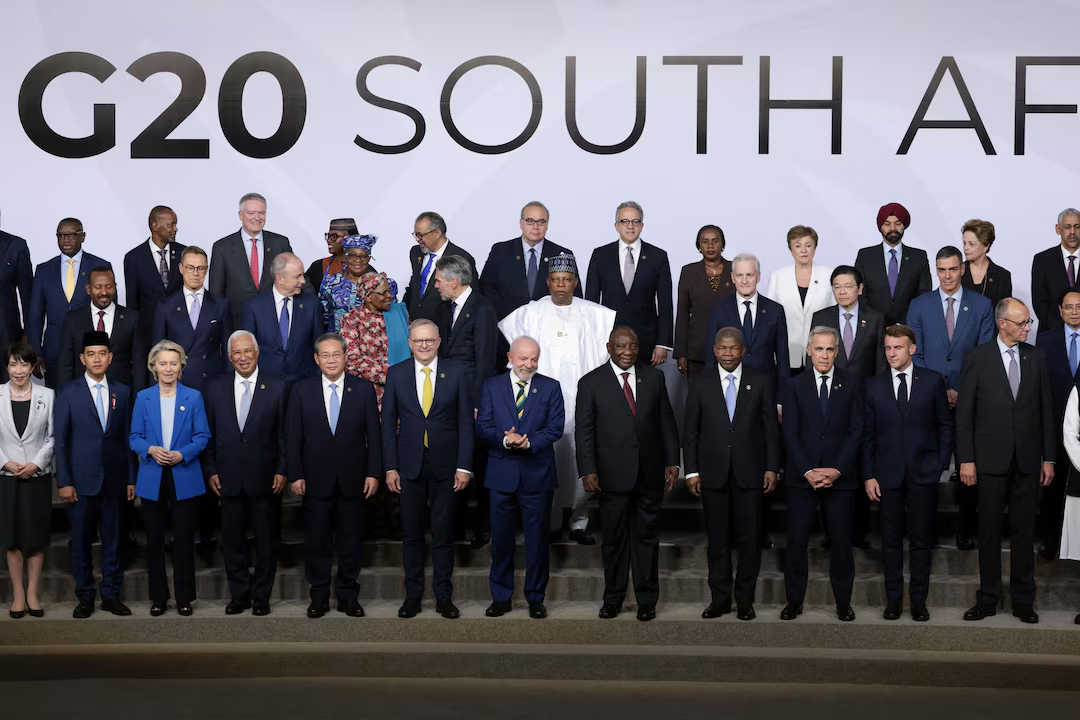

The G20 Leaders’ Declaration, issued following two days of talks hosted by South Africa, reaffirms the Group of Twenty’s support for digital and emerging technologies — including artificial intelligence — “for good and for all,” while pushing governments and stakeholders to turn principles into concrete action. The declaration highlights both the promise and risks of rapid AI deployment and calls for cooperation on standards, safety, privacy and equitable access.
Crucially for African nations, the Johannesburg declaration elevates the continent as a priority for targeted AI investments and partnerships. The document calls for the development of sovereign AI capabilities, expanded data infrastructure, and long-term investment models that aim to move African economies up the global value chain rather than simply supplying raw materials. TechCabal’s analysis of the declaration notes the shift from rhetorical inclusion to frameworks that encourage local capacity and value capture.
To operationalize these ambitions, leaders agreed to work on interoperable, rights-based data governance frameworks to enable innovation while safeguarding privacy and security. The declaration urges multilateral cooperation on data portability, cross-border data flows, and standards for algorithmic safety and transparency. Observers say these provisions are intended to help African governments balance data sovereignty with participation in the global digital economy.
On finance and direct support, summit statements and press coverage describe an initial package of targeted resources for African tech ecosystems. Media reports and summit communiqués reference a USD-100 million startup fund and commitments to skills and infrastructure investments — packages that, if delivered, would underpin incubation, R&D, and local scaling of AI businesses across the continent. The G20’s official documents make clear, however, that detailed implementation will depend on participation by multilateral development banks, private investors and national governments.
Reaction from stakeholders was mixed but constructive. African institutions welcomed the emphasis on sovereignty and skills, while international policy watchers cautioned that success will hinge on translating broad pledges into enforceable financing, procurement strategies, standards adoption, and measurable capacity building. The Atlantic Council and other think tanks warned that the declaration’s ambitions will require fast follow-through to avoid becoming yet another list of good intentions.
Why this matters:
Placing Africa explicitly at the centre of AI and data partnerships marks a departure from earlier G20 language that tended to treat the continent as a beneficiary rather than a partner in technology creation. If implemented, the Johannesburg commitments could accelerate an African tech renaissance — from sovereign data clouds to homegrown AI models — and shift where value is created and retained in global digital supply chains.
What to look out for in the coming months:

Which institutions will seed and manage the reported USD-100m fund, and what strings or governance rules will attach.
How the G20’s data governance language is translated into regional agreements (e.g., African Union or AfCFTA member states).
Practical steps for capacity building: national AI strategies, public-sector procurement for local AI firms, and teacher/training programs.