









Germany Unveils Sweeping Economic Reforms: Tax Relief, Pension Overhaul, and Labour Law Shifts Signal Competitiveness Push

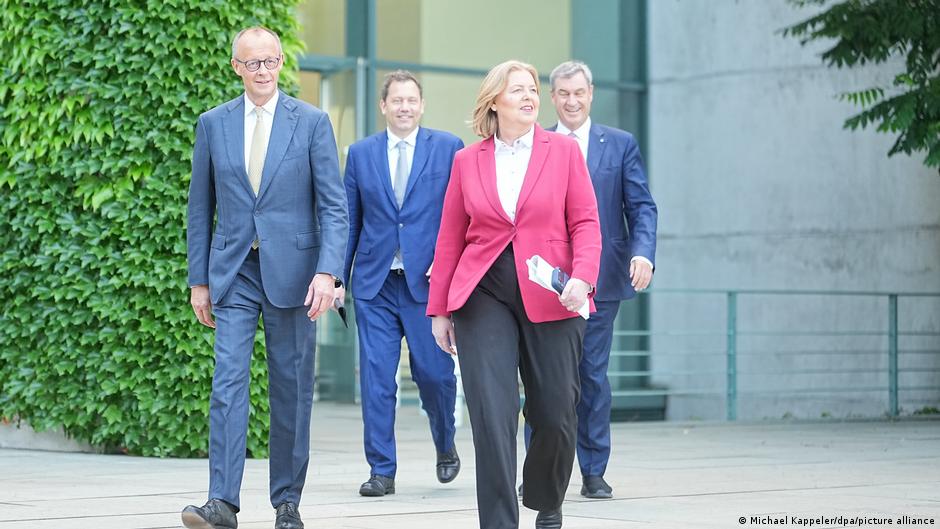

Chancellor Friedrich Merz announced today that Germany’s ruling coalition has reached an agreement on a comprehensive package of reforms designed to modernise the nation’s economy and bolster its global competitiveness. The landmark deal, finalised by leaders of the conservative CDU/CSU bloc and the centre-left Social Democrats (SPD), introduces significant changes across taxation, pensions, labour law, and industrial policy, aiming to revitalise Europe’s largest economy.
The reform package, detailed following a crucial meeting of coalition leaders in Berlin, includes €10 billion in annual income tax relief for households. This measure is partially funded by an increase in the top tax rate for very high earners, from 45% to 47%. In a notable shift for labour relations, the government will abolish the practice of issuing sick notes via telephone, mandating medical certificates from the first day of illness. Furthermore, the reforms aim to provide businesses with greater flexibility concerning fixed-term employment contracts and dismissals for high-earning employees.
The coalition’s plan also encompasses a significant overhaul of the pension system. By the end of 2026, Germany will implement proposals from a dedicated pension commission, introducing a new investment-based component to the predominantly pay-as-you-go state pension system. This initiative is coupled with a gradual increase in the retirement age over the coming decades.
In a statement released following the announcement, Chancellor Merz emphasised the government’s commitment to stimulating economic activity. “We are providing relief to employees and businesses by cutting taxes and reducing bureaucracy,” Merz stated. “We have now completed our first year of reform. From the very beginning, we set an agenda serving a single goal: We want to get Germany moving again. It is now clear that this is possible.” The reforms come amid pressure on Merz to invigorate the economy, particularly as his party faces challenges in opinion polls.
The reform package is structured to address several key sectors. Industrial support will be directed towards strategic areas including automotive, chemicals, pharmaceuticals, batteries, semiconductors, artificial intelligence, and clean technology. Measures to combat welfare fraud will be tightened through enhanced data sharing and enforcement. The energy sector will see accelerated electricity grid expansion and clearer timelines for industrial grid connections. In international trade, Germany will bolster EU anti-dumping and anti-subsidy tools, with increased scrutiny on strategic non-European investments. The housing sector will benefit from the creation of a federal housing company, support for affordable housing, and eased mortgage financing. Bureaucratic hurdles for companies are targeted for reduction, with fewer forms and reporting duties, and provisions for automatic approval of certain applications if officials fail to respond within four months.
The coalition leaders expressed strong support for the agreed-upon measures. SPD co-leader and Finance Minister Lars Klingbeil believes the reforms will garner broad public support, particularly due to their emphasis on fairness. He stated that the coalition had “agreed on solutions that can be supported by a broad majority of our society,” adding his conviction that these decisions would “give our country new strength.” SPD co-leader Bärbel Bas highlighted the package’s potential to “ensure that the economy grows again, that we achieve growth and secure jobs, while maintaining social balance, and, above all, that we strengthen cohesion within our country.” Markus Söder, leader of the CSU, described the package as “well-rounded,” acknowledging that while each coalition partner might have desired more in specific areas, the outcome reflects the nature of compromise within a coalition. He characterised the package as a step away from economic stagnation.

The business community has largely welcomed the reforms. Deutsche Bank CEO Christian Sewing hailed the package as a “very successful starting point” that supports calls for growth-promoting reforms. He urged the government to maintain momentum and pursue further initiatives. The German Insurance Association (GDV) also expressed strong approval, with Managing Director Jörg Asmussen stressing the importance of “swift and consistent implementation.” Rainer Dulger, president of the Confederation of German Employers’ Associations, described the reforms as a “long-overdue change of course” that strengthens competitiveness and confidence, though he also called for further measures to address high social security contributions.
However, the reforms have drawn criticism from some labour unions and political parties. The Verdi services trade union has decried the requirement for medical certificates from day one of illness as an indicator of a “culture of mistrust.” Frank Werneke, head of Verdi, argued that “mistrust toward employees and the expansion of the madness of fixed-term employment contracts do not create growth.” IG Metall, Germany’s largest trade union, offered a more mixed assessment, welcoming tax relief but lamenting the expansion of fixed-term contracts as an “attack on workers’ rights” and the abolition of telephone sick notes as fulfilling an “antisocial wish list” of employers.
Felix Banaszak, co-leader of the Green Party, criticised the package as a “vote of no confidence in citizens.” The socialist Left Party condemned the reforms as a “program of mistrust and ignorance,” asserting that tax reductions do not compensate for rising living costs and insecure pensions. Family doctors have also voiced strong opposition, with Markus Blumenthal-Beier, chairman of the German Medical Association, describing the plans for sick notes as “absolutely catastrophic” and predicting a “massive wave of bureaucracy” and increased waiting times for patients.