Shettima Reaffirms FG’s Commitment to Business Environment Reforms, Cites Employer Engagement as Crucial

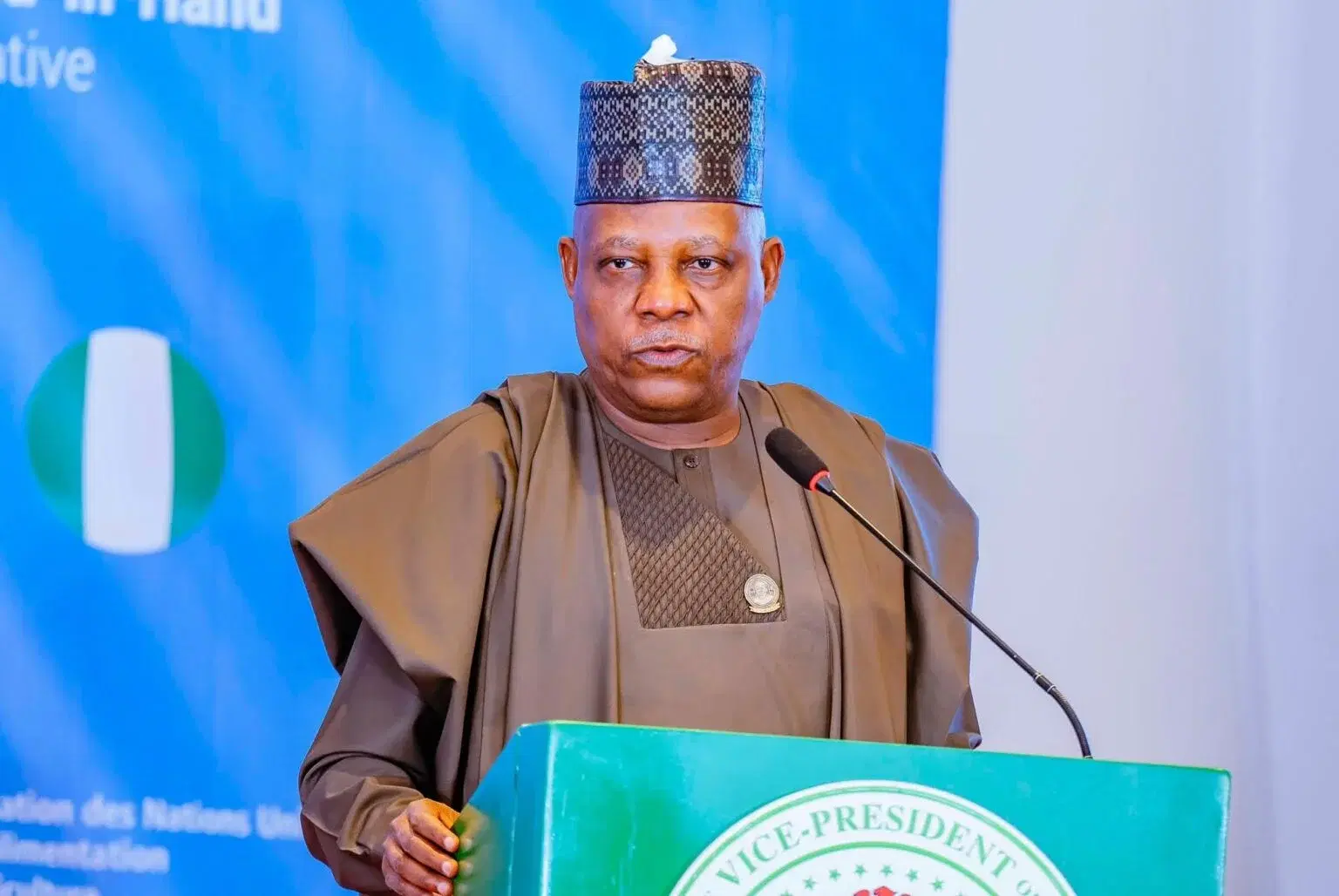

Vice President Kashim Shettima has underscored the Federal Government’s unwavering commitment to fostering a more conducive business environment by actively engaging with employers and systematically dismantling operational impediments. Speaking at the 5th Nigerian Employers’ Summit in Abuja, the Vice President, represented by Dr. Aliyu Modibbo Umar, Special Adviser to the President on General Duties, stressed that any administration that neglects the insights and challenges faced by employers cannot achieve a comprehensive understanding of the nation’s economic landscape.
The Federal Government, Shettima stated, is dedicated to reducing bottlenecks and accelerating the digitisation of government processes. This initiative aims to ensure that the reforms announced in Abuja are not merely theoretical but are tangibly experienced by businesses across Lagos, Kano, Aba, and indeed, all regions of Nigeria, without undue delay. The summit, he noted, was particularly timely given Nigeria’s current economic juncture, which demands difficult but necessary conversations regarding production costs, access to credit, exchange rate stability, taxation, and investment.
The Vice President articulated that private sector competitiveness hinges not on sentiment but on tangible factors such as functional infrastructure, predictable policy frameworks, equitable taxation, and reliable energy supply. He commended President Bola Tinubu for his decisive actions, asserting that thriving economies are not accidental but the result of strategic foresight and the courage to implement transformative reforms. Shettima emphasised the critical synergy between vision and resolve, stating that responsible leadership requires both the foresight to identify necessary changes and the determination to enact them, even when the path is challenging.
The 5th Nigerian Employers’ Summit, a key platform for discussions on enterprise sustainability, job creation, and inclusive growth, was acknowledged for its role in strengthening dialogue between government and the organised private sector. The Vice President lauded the Nigeria Employers’ Consultative Association (NECA) for its nearly seven decades of service as a credible voice for employers, effectively bridging communication between government, labour, development partners, and the business community.
Shettima recalled the economic realities upon President Tinubu’s assumption of office, including the fiscal unsustainability of fuel subsidies, a fragmented foreign exchange market, weak government revenue, and the imperative to rebuild investor confidence. He highlighted that the “Renewed Hope Agenda” was conceived to address these structural burdens, positing that leadership is defined by the willingness to make difficult but correct decisions. The administration’s reforms are designed to rectify fundamental economic distortions, attract investment in an environment of exchange rate certainty, and foster job creation by alleviating the burdens of multiple taxation, logistical inefficiencies, and insecurity that stifle enterprises.
The core objective of these reforms, Shettima explained, is to establish a stable economic foundation, which he described as the primary infrastructure for business. Restoring macroeconomic stability was identified as the immediate priority, as businesses require confidence to plan and invest before they can leverage physical infrastructure like roads and ports. Consequently, the removal of fuel subsidies and the reform of the foreign exchange market are central to the government’s strategy. The subsidy, he argued, had previously diverted investment and encouraged inefficiency, while the foreign exchange reforms are intended to foster a more transparent and market-reflective system.

Fiscal and tax reforms are being pursued with a similar logic. The government recognises that businesses do not oppose taxation per se, but rather multiple taxation, harassment, and systems that penalise compliance while favouring informality. The current agenda aims to reduce the number of taxes, harmonise administration, protect vulnerable segments of the population, support small businesses, and incentivise compliance through lower rates and a broadened tax base to fund essential infrastructure. The Vice President reiterated the private sector’s fundamental request: that the government refrain from making the process of doing business unnecessarily difficult, acknowledging that every delayed approval and ambiguous regulation imposes tangible costs on enterprises.
In his address, NECA Director-General, Mr. Adewale Oyerinde, noted that the summit has consistently delivered practical policy recommendations that have been valuable to successive governments. He highlighted the summit’s impact in shaping national discourse and enhancing confidence between the government and the organised private sector over its five-year history.